
The IP Brief - March 2026
Download PDF VersionIntroduction
Welcome to our latest edition of The IP Brief – a quarterly update of key IP cases and news, with a primarily UK and EU focus.
In this edition, we take a look at:
- the UK Supreme Court’s decision in Emotional Perception v Comptroller General of Patents, which considered the patentability of artificial neural network-implemented inventions in the UK;
- the CJEU’s decision in the joined cases of Mio and konektra, clarifying how EU Member States should assess originality and infringement of works of applied art in a copyright context;
- the UK Supreme Court’s confirmation that a UK trade mark registration for “POST MILK GENERATION” was invalid for oat-based food and drink products because its use in relation to such products in the UK is prohibited by law;
- two recent decisions of the UK Court of Appeal considering the registrability requirements for UK trade marks and the nature of a “sign” for those purposes; and
- the UK Court of Appeal’s thoughts on the limits of the exhaustion of rights defence in a trade mark infringement context.
PATENTS
Emotions run high in UK Supreme Court as Aerotel approach rejected
On 11 February 2026, the UK Supreme Court handed down its highly anticipated decision in Emotional Perception v Comptroller General of Patents, finding that an artificial neural network ("ANN") is a computer program, but that Emotional Perception’s claimed ANN invention was not excluded from patentability as a computer program “as such”. In reaching this conclusion, the Supreme Court rejected the traditional “Aerotel” approach to applying the computer program exclusion – which has been followed and applied by the English courts for nearly 20 years – adopting instead the “any hardware” approach of the European Patent Office ("EPO").
Background
The question at the heart of this long-running dispute is, in essence, whether it is possible to patent an ANN-implemented invention in the UK – here, an ANN which has been trained to recommend files (such as music tracks) to end users based on human perception and emotion (e.g. how the music makes them feel).
UK patent law excludes computer programs “as such” from patentability and so, naturally, the question arose as to whether ANNs are computer programs and, if so, whether Emotional Perception’s ANN-implemented invention falls within that exclusion.
Since 2006, the English courts have applied the following four-stage approach (known as the Aerotel approach) to determine whether the computer program exclusion applies:
(1) properly construe the claim;
(2) identify the actual contribution;
(3) ask whether it falls solely within the excluded subject matter; and
(4) check whether the actual or alleged contribution is actually technical in nature.
Applying this approach, at first instance the UK Intellectual Property Office (UKIPO) found that the computer program exclusion applied and that Emotional Perception’s invention was not therefore patentable. That finding was overturned by the High Court; and the High Court’s decision itself was later overturned by the Court of Appeal, which reinstated the UKIPO’s decision. All of which highlights the complexities surrounding the patentability of inventions of this kind.
On further appeal to the Supreme Court, three core issues were raised:
- Should the English courts reject the Aerotel approach?
- Is an ANN a computer program?
- Are Emotional Perception’s claims excluded from patentability?
Should the court reject the Aerotel approach?
Perhaps slightly unexpectedly, given its long-standing nature and the lack of debate on this point in the lower courts, the Supreme Court agreed unanimously to reject the Aerotel approach, finding that the Court of Appeal in Aerotel had misinterpreted the relevant provisions of the European Patent Convention ("EPC").
In its place, the Supreme Court adopted the “any hardware” approach, which was endorsed by the Enlarged Board of Appeal of the EPO in 2021 in a case commonly referred to as “G1/19”. Under that approach, an application will not be rejected under the computer program exclusion if the subject matter of the claim involves the use of any hardware, such as a computer. If that (low) hurdle is overcome, the courts will then apply an “intermediate step” to determine which features of the invention contribute to its technical character, before considering whether the invention is novel and involves an inventive step.
In reaching this decision, the Supreme Court reminded us that the UK Patents Act 1977 aimed, in part, to bring UK patent law into line with the EPC and that certain sections of the Patents Act (including the computer program exclusion) need to be read in such a way as to give them, “as nearly as practicable”, the same effect as the equivalent provisions in the EPC. In that context, the court also gave a helpful reminder of the weight to be given to decisions of the EPO on the meaning of the EPC. Whilst not strictly bound by such decisions, the English courts should “respect and follow the Enlarged Board’s decisions and any uniform jurisprudence of the Boards of Appeal unless convinced that they are wrong or beyond the ambit of reasonable difference of opinion”.
The Aerotel approach was adopted at a time when there were no decisions of the Enlarged Board on this point and no clear approach at the EPO Board of Appeal level. However, in Aerotel itself, Jacob LJ had alluded to the fact that the English courts might need to reconsider their approach if/when the Enlarged Board ruled on this issue. The Enlarged Board eventually gave such a ruling 15 years later, in March 2021 (G1/19), which not only confirmed a different approach to that of the English courts but also approved earlier comments from the EPO Board of Appeal that criticised the Aerotel approach as being incompatible with the EPC. In those circumstances, and whilst acknowledging the potential disruption changing an embedded approach like Aerotel might entail, the Supreme Court concluded it was right to reject the Aerotel approach and adopt the EPO’s any hardware approach. This applies as much to UK patents as to European patents designating the UK, given the way the UK Patents Act is to be read.
Is an ANN a computer program?
With the approach to exclusions settled, the Supreme Court went on to consider whether an ANN is a computer program and therefore whether the computer program exclusion was engaged at all by Emotional Perception’s application. It found that it is and that the exclusion was therefore engaged.
In coming to this conclusion, the Supreme Court dismissed as overly broad the Court of Appeal’s characterisation of a computer as “a machine which processes information”. At the same time, however, it found that “computer” does not need to be confined to the conventional digital computers that we are familiar with. Instead, it must be a flexible term that can accommodate technological change, including quantum computers.
In turn, the definition of “computer program” must be equally broad and capture any “set of instructions capable of being followed by a computer (of any kind)…to produce desired manipulations of data”.
Applying this to an ANN, the Supreme Court found that an ANN is a computer program, and not a computer.
Is the entire subject matter of Emotional Perception’s claims excluded?
That left the Supreme Court to determine whether Emotional Perception’s application fell foul of the computer program exclusion. Applying the “any hardware” approach, the Supreme Court found that it was “beyond dispute” that the claims were to an invention and not excluded. The claims in question clearly involved the use of hardware, including a computer and a user device.
Given the case before it had only been argued on the basis of the Aerotel approach, the Supreme Court decided not to take things further and remitted the case back to the UKIPO to apply the “intermediate step” and then determine whether Emotional Perception’s invention is patentable.
Comment
The Supreme Court’s decision in this case has brought about a significant change to the way the English courts will assess the computer program exclusion from patentability going forwards, significantly lowering the hurdle that needs to be overcome and paving the way for increased patentability of ANNs and other computer-implemented inventions. In doing so, the decision brings the UK more into line with the EPO’s approach, creating a further measure of harmonisation within Europe, and, more broadly, suggests that UK practitioners and the English courts should perhaps be paying more attention to decisions of the Enlarged Board, and any uniform jurisprudence of the Boards of Appeal, of the EPO than they may have done in the past.
However, it remains to be seen how the English courts will apply aspects of this decision (such as the intermediate step) in practice, whether this decision will lead to any adjustments in the English courts’ approach to assessing novelty and inventive step (the Supreme Court indicated it did not expect any immediate impact but did acknowledge that they “may require some modification”), and whether the changes made will ultimately lead to different outcomes on patentability.
COPYRIGHT
Mio & konektra – CJEU confirms artistic merit is off the table
Last Summer, we reported on Advocate General (“AG”) Szpunar’s opinion on the joined cases of Mio and konektra. Shortly before Christmas, the CJEU issued its decision in this case. That decision is broadly aligned with the AG’s opinion and clarifies how Member States should assess originality and infringement of works of applied art.
By way of brief reminder, both cases concern copyright protection for pieces of furniture; in Mio this was a table and in konektra it was a modular furniture system. Prompted by evolving CJEU jurisprudence (including Cofemel and Brompton Bicycle), which has extended the scope of copyright protection to works that were traditionally associated with more limited design protection, the German and Swedish courts referred three key questions to the CJEU. These can be summarised as follows:
- Is there a relationship of rule and exception between copyright protection and design protection?
- How should Member States assess the originality of works of applied art?
- How should infringement of copyright in works of applied art be assessed?
The first question stemmed from the CJEU’s decision in Cofemel. Whilst the CJEU clearly established in that case that design protection and copyright protection are not mutually exclusive, confusion remained over the CJEU’s comment that design protection and copyright protection could be available concurrently “only in certain situations”.
Agreeing with AG Szpunar, the CJEU confirmed that this statement does not suggest a relationship of rule and exception between copyright and design protection. Rather, each form of protection operates independently, pursuing different objectives and utilising different tests. Copyright and design protection for any given work must therefore be assessed independently, according to the established tests for each (originality for copyright; novelty and individual character for designs).
In that regard, endorsing the AG’s findings, the CJEU reiterated that, when assessing the originality of works of applied art, the core question remains the same as for all other types of work – does the work reflect the author’s personality as an expression of their free and creative choices? Member States cannot apply a stricter threshold when considering works of applied art, meaning any artistic merit or aesthetic value test is off the table.
But how can free and creative choices be expressed in utilitarian objects, such as furniture? Well, the CJEU confirmed that the absence of an artistic visual effect does not necessarily equate to a lack of originality or creativity. Whilst some elements might be purely dictated by technical, ergonomic or safety constraints, others won’t be. The CJEU confirmed that those elements that are dictated by such constraints, particularly technical, will not be free and creative and will not therefore be original for copyright purposes. Even where there are no such constraints, however, originality will not be presumed - it will be for the party seeking to enforce their copyright to identify the (free and) creative choices “in the shape” of their work and convince the court that they reflect their personality.
In seeking to establish this, the CJEU encouraged Member State courts to take account of all relevant factors that existed at the point of creation. This could include:
- the author’s intentions during the creative process, where those intentions are expressed in the work itself;
- the author’s sources of inspiration and incorporation of elements that were already publicly available;
- the likelihood of third parties independently creating something similar; and
- recognition in professional circles and display in museums.
However, the CJEU made it clear that none of these factors are necessary or decisive for establishing originality and that the courts have broad discretion to apply them as appropriate. This clearly leaves Member State courts with a certain level of flexibility, so it will be interesting to see how they implement it in practice.
As for the test for infringement, the CJEU reaffirmed the AG’s proposed “recognisability” test – infringement will be found where the original creative elements of the protected work are reproduced in a “recognisable manner” in the allegedly infringing product. Comparisons of “overall impression” are irrelevant (being questions of design law). An entire product may therefore be enjoined for copyright infringement if it reproduces just one original creative element of the earlier work even where the overall impression given by the product is very different from that earlier work.
The CJEU also confirmed that there’s no correlation between the degree of originality of a protected work and the extent of protection afforded to it. Provided originality is established, the work will receive full copyright protection.
Overall, the CJEU’s decision to follow AG Szpunar on the first two questions is unsurprising. What is perhaps more surprising is its decision to adopt AG Szpunar’s proposed “recognizability” test for infringement, without any discussion or analysis. In doing so, it has introduced an additional “recognizability” element into the test for copyright infringement. Such a test has previously only been applied in the context of sound recordings and the CJEU provided no reasoning or rationale for extending this approach to copyright infringement more generally. Nor did it explain how this additional element should be applied in practice (e.g. from whose perspective is recognizability to be assessed)? It may be that this doesn’t move the needle much, if at all, given that in most cases of copyright infringement the copied elements of the protected work will be “recognisable” in the infringing work in any event. However, it would have been helpful for the court to explain its rationale and intention given the fundamental nature of this test to a finding of infringement.
Of course, this decision isn’t binding in the UK, but English courts are likely to have regard to it. So far, only England’s lower courts (see e.g. WaterRower v Liking, which we commented on in our March 2025 edition of The IP Brief) have reviewed the inconsistency between UK and EU copyright law relating to works of applied art. The question of the interplay between design rights and copyright is, however, being considered as part of the UKIPO’s design rights consultation (see our November 2025 edition of The IP Brief), so we may receive some clarity on the direction of travel of UK copyright law vis-à-vis the EU on this point when the outcome of that consultation is published.
TRADE MARKS
UK Supreme Court confirms Oatly’s “POST MILK GENERATION” mark is invalid for oat-based food and drink
The UK Supreme Court has declared the UK registered trade mark “POST MILK GENERATION” invalid for oat-based food and drink because its use in relation to such products in the UK is prohibited by law.
Oatly is a Swedish producer of oat-based food and drinks, which are marketed as alternatives to dairy products. In November 2019, it applied to register “POST MILK GENERATION” as a UK trade mark for use in relation to oat-based food and drink, as well as T-shirts. Registration was granted in April 2021, following which Dairy UK (the trade association for the UK dairy industry) challenged the registration’s validity.
One of the grounds of challenge was that use of the mark “POST MILK GENERATION” for oat-based food and drink is prohibited in the UK under EU Regulation (1308/2013) establishing a common organisation of the markets in agricultural products (the “2013 Regulation”), which regulates the use of dairy terms including “milk”. In particular, the 2013 Regulation states that designations of “milk” and “milk products” may not be used for any product other than those stated in the 2013 Regulation (all of which are dairy products). However, the 2013 Regulation goes on to state that that prohibition does not apply “when the designations are clearly used to describe a characteristic quality of the product” (the proviso).
Dairy UK argued that use of “POST MILK GENERATION” for oat-based food and drink would breach the terms of the 2013 Regulation and that the mark was therefore invalid under Section 3(4) of the Trade Marks Act 1994.
At first instance, the UK Intellectual Property Office sided with Dairy UK, finding that use of the mark in respect of oat-based food and drink (but not T-shirts) was prohibited by the 2013 Regulation since the mark contained the word “milk”, but the goods listed in the specification were not milk. The hearing officer also concluded that the proviso didn’t apply because “the mark does not clearly describe a characteristic quality of the goods”. This decision was overturned on appeal to the High Court, whose decision was, in turn, overturned by the Court of Appeal.
Oatly subsequently appealed to the Supreme Court, where two core issues arose.
(1) What is the meaning of “designation” in the 2013 Regulation? Does it only cover the name of a product or is it broader than that? And does “POST MILK GENERATION” fall within the scope of the general prohibition in the 2013 Regulation on the basis that it uses the term “milk” as a designation?
(2) Even if the mark does fall within the scope of the general prohibition in the 2013 Regulation, is it saved by the proviso?
Considering first the interpretation of “designation”, the Supreme Court held that, when read in context, it should be understood as meaning the use of the word “milk” in respect of a product broadly, rather than only the name of a product itself. It followed that “POST MILK GENERATION” is a designation under the 2013 Regulation and could not be used in respect of oat-based food and drink products because such products are not referred to in the relevant “milk” and “milk products” section of the 2013 Regulation.
As for whether Oatly could avail itself of the proviso, the Supreme Court found that it could not. This was because “POST MILK GENERATION” does not clearly describe a characteristic quality of the product itself (i.e. that it is milk-free). Instead, the Court found that it describes the targeted consumers (i.e. a younger generation which is more sceptical about milk than its predecessors).
This is in contrast to a mark like “MILK-FREE”. Such a mark would be a prohibited designation on its face if it were used in relation to oat-based food or drink, but it would be saved by the proviso as it clearly describes a characteristic quality of the product.
What does this mean for businesses? For those operating in the dairy alternatives market, the judgment confirms that care needs to be taken when using dairy terms to describe or market non-dairy food and drink products. While dairy terms may be used to clearly describe the characteristic quality of the product itself (e.g. that it doesn’t contain dairy), their use as a part or the whole of a trade mark is otherwise restricted. Businesses will therefore need to think twice about using dairy terms on branding or marketing relating to dairy-free food or drink products.
More broadly, the decision serves as a reminder that UK registered trade mark protection is not available for marks whose use is prohibited in the UK by law.
Court of Appeal guidance on what constitutes a “sign” for UK trade mark registration purposes
Two recent Court of Appeal decisions provide guidance on what constitutes a “sign” capable of registration under UK trade mark law, as well as the precision required when defining it. In Thom Browne Inc v Adidas AG and Babek International Ltd v Iceland Foods Ltd, the court considered whether certain registrations should be declared invalid on the grounds of being unclear or by including an impermissible range of variations. Read together, the judgments reaffirm that clarity, precision and internal consistency are central to registrability, particularly for non-traditional marks and marks accompanied by written descriptions.
Thom Browne Inc v Adidas AG
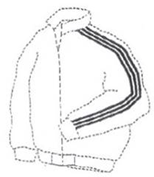
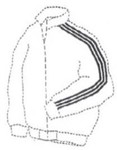
The adidas litigation (which we have previously commented on) concerned the validity of a number of trade marks protecting the placement of adidas’s “three-stripe” branding on clothing and accessories. The marks were registered as position marks, protecting the positioning of a sign on goods rather than the sign in isolation. An example is set out below.
  |
|
Under section 1(1) of the Trade Marks Act 1994, as it was at the time the adidas (and Babek) marks were registered, a sign was registrable only if it: (i) constituted a sign; (ii) was capable of being represented graphically, i.e. represented on the register with sufficient clarity and precision to enable the registrar, competitors and the public to determine what falls within the scope of protection; and (iii) was capable of distinguishing the goods or services of one undertaking from those of others.
Thom Browne sought to invalidate sixteen of adidas’s “three stripe” registrations, arguing that they did not constitute single, clearly identifiable signs, in breach of the first and second requirements noted above. Its case was that each registration purported to cover a range of stripe configurations, varying in length, orientation and position, rather than one defined sign, and lacked the clarity and precision required for registration.
Applying the “clear and precise” test, the courts examined the relationship between the graphic representations and the descriptions for each adidas mark. Eight registrations were held invalid (including the one extracted above); the decisive flaw being wording that allowed multiple materially different permutations. Expressions such as “running along one third or more of the length”, “substantially the whole length”, and “generally used vertically” were inherently open-ended, covering a wide range of stripe arrangements not clearly depicted in the illustrations. Therefore, the difficulty for adidas’ marks was that, although some limited variation may be tolerated, reading the image together with the description resulted in multiple possible claimed signs, particularly as to the length and positioning of the stripes.
The decision highlights a recurring difficulty with position marks. Unless the description is tightly anchored to the precise configuration shown, there is a real risk of the registration being construed as claiming a multitude of signs rather than a single sign, which is not permitted under UK trade mark law.
Babek International Ltd v Iceland Foods Ltd
The court addressed similar issues (albeit from a slightly different angle) in Babek, which concerned a figurative logo mark consisting of an oval badge bearing the word “BABEK” in stylised lettering. The registration included both a graphic representation and a brief description referring to a “gold oval” with “embossed” wording (see below).
 |
Type of mark: figurative Indication of colour(s): Gold and Black Description of the mark: Gold Oval with Embossed BABEK writing. |
Iceland argued that the mark as registered was not defined with sufficient precision, potentially covering variations in colour and style beyond a single identifiable sign.
Reaffirming that image and description must be read together, the court held that the description did not expand the scope of the mark in this case, or create ambiguity, but merely described features apparent from the image. Minor visual nuances, such as tonal variation or embossing, were treated as inherent aspects of the single clear and precise sign.
Whilst a written description is not mandatory, where a description is provided, the court confirmed that exhaustive detail is not required. Provided the sign is delineated with sufficient certainty to be identifiable as a single sign and capable of distinguishing origin, the basic registrability threshold will be met.
Practical implications
These decisions underline several practical points for UK trade mark applicants.
- Claim a single sign. Avoid framing applications so broadly as to encompass multiple signs. Where variations matter, separate registrations are safer, though each must be put to genuine use to avoid the risk of revocation for non-use.
- Scope of protection. Remember that the scope of protection extends beyond what is on the register (i.e. a third party sign does not need to be identical to the registered mark to infringe), so you do not need to cover every permutation in a registration.
- Use descriptions carefully. Where used, written descriptions must align closely with the graphic representation. Open-ended language risks invalidity. In some cases, it may be safer not to provide a description at all.
Exhaustion has its limits: UK Court of Appeal draws a clear line on aftermarket branding
In AGA Rangemaster Group v UK Innovations Group, the Court of Appeal has upheld findings of trade mark infringement against UK Innovations Group Ltd ("UKIG") for the way UKIG marketed refurbished AGA cookers fitted with its eControl System. In reaching that conclusion, the Court confirmed that, whilst resellers will often be able to rely on the defence of exhaustion of rights where the goods in question have been legitimately placed on the UK market, that defence will not be available where the reseller’s actions falsely give the impression of a commercial connection with the trade mark owner.
AGA brought proceedings against UKIG in 2024 for trade mark and copyright infringement relating to UKIG’s sale of second‑hand AGA cookers that it had converted to run on electric power instead of fossil fuels. The converted cookers retained their original AGA branding but were fitted with UKIG’s “eControl System” and bore a corresponding badge. Whilst UKIG accepted that they were using the AGA marks within the meaning of section 10 of the Trade Marks Act 1994 (“TMA”), they argued that they were not infringing AGA’s trade marks as the AGA cookers in question had been placed on the market by AGA (or with its consent) and AGA’s trade mark rights had therefore been exhausted. AGA disagreed. It acknowledged that there is a legitimate aftermarket for refurbishing and reselling AGA cookers, but it argued that UKIG’s actions, particularly the way it marketed its retrofitted cookers, went beyond what was permissible and infringed its trade mark rights (as well as certain copyright).
As we reported in our November 2024 issue of The IP Brief, at first instance the Intellectual Property Enterprise Court ("IPEC") found in favour of AGA, holding that UKIG could not rely on an exhaustion defence. AGA had legitimate reasons to oppose further dealings in the refurbished cookers because UKIG’s dealings, particularly the way it marketed and sold the cookers through composite labels such as “eControl AGA” or “AGA eControl”, gave the impression that there was a commercial connection between UKIG and AGA.
UKIG challenged this decision before the Court of Appeal on two grounds. Firstly, it argued that the IPEC had applied the wrong legal test for determining whether AGA had legitimate grounds to oppose. Secondly, it submitted that the IPEC’s conclusion that UKIG’s website and invoices were likely to give customers the impression of a commercial connection between UKIG and AGA was rationally unsupportable.
UKIG’s arguments were dismissed on both grounds. In relation to the first, the Court of Appeal confirmed that the correct legal test for the presence of legitimate grounds to oppose on the basis of a commercial connection (outside of keyword advertising cases), is simply to ask whether the reseller’s conduct creates the impression of a commercial connection. The IPEC’s reference to a test based on customers only being able to ascertain “with difficulty” whether the goods originate from the trade mark owner or a third party was not appropriate in cases that do not involve internet keyword advertising. However, the Court of Appeal went on to find that when the IPEC actually came to decide the issue, the judge had not applied that test; rather, the judge had simply concluded that UKIG’s statements were likely to give the impression that UKIG’s “eControl” products were part of an AGA product range.
As for the second ground, the Court of Appeal found the High Court’s factual conclusion to be amply supported. Composite labels such “eControl AGA” or “AGA eControl” were not the only options available to UKIG and it could have dispelled any false impressions of a commercial connection using clear statements to that effect.
Separately to the trade mark infringement and exhaustion points noted above, AGA also argued that UKIG had infringed the copyright in its design drawing for a control panel by making its own control panel to that design. The IPEC agreed that AGA’s design drawing attracted copyright protection and that UKIG had indirectly copied it. However, it found that there was no copyright infringement because UKIG could rely on the defence in Section 51 of the Copyright, Designs and Patents Act 1988 ("CDPA"), which provides that making an article to a design will not infringe copyright in the underlying design document where the design embodied is for anything other than an artistic work. AGA sought to challenge this conclusion by arguing that the control panel is an artistic work, specifically a graphic work. The Court of Appeal, however, firmly rejected that claim. While the Court acknowledged that there were graphic or artistic elements to the control panel and that it was “a thing to be looked at”, it was still primarily a functional object and not a graphic or artistic work.
Overall, this case serves as an important reminder that whilst the principle of exhaustion of rights enables the legitimate resale of genuine goods, it has its limits and will not shield marketing that creates the impression of a commercial connection between the reseller and trade mark owner (or their products) where none exists. Aftermarket businesses should take care to describe any refurbished or converted goods clearly and avoid using composite labels that might risk creating false impressions of a commercial link (whether at product or undertaking level).
With thanks to Peter Elkin, Issabella Cardu, Ioanna Antcheva and Rosie Wilson for their contributions to this edition.







If you would like to discuss any of the above in more detail, please contact your relationship partner or email one of our IP team.
If you would like to receive The IP Brief on a quarterly basis, please email [email protected].
This material is provided for general information only. It does not constitute legal or other professional advice.