
Employment Rights Act
Updates & Insights on the Employment Rights Act 2025
The Employment Rights Act 2025 received Royal Assent on 18 December 2025, marking a pivotal moment in UK employment legislation. Widely regarded as the most significant upgrade to workers’ rights in a generation, the Act introduces 28 wide ranging reforms that will reshape the employment landscape for years to come. From a new unfair dismissal regime and guaranteed hours for casual workers, to enhanced trade union access and new liabilities for workplace harassment, the Employment Rights Act signals a decisive shift in how employers engage with their workforce.
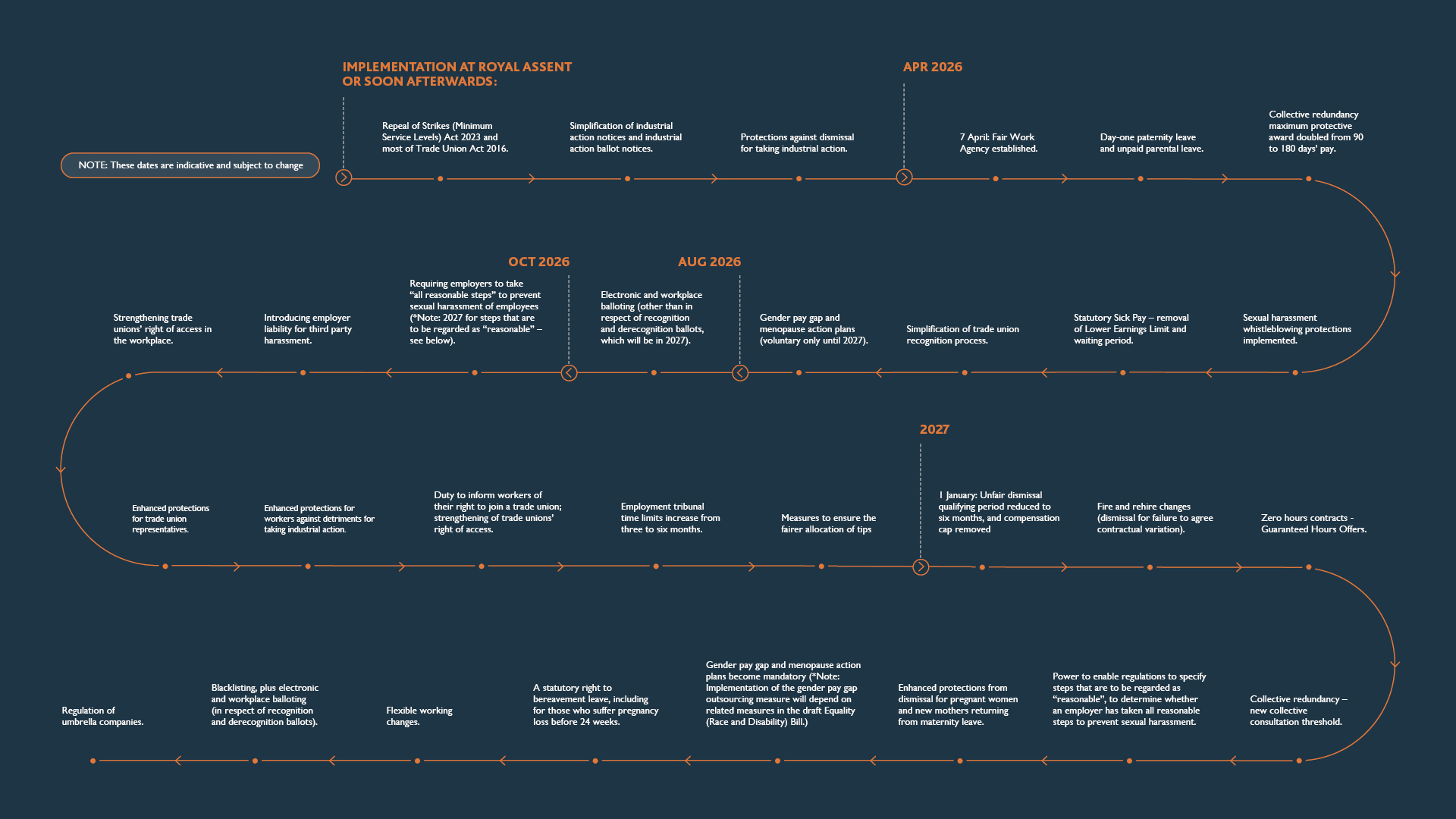
While implementation will be phased, the first wave of changes in February 2026 is particularly relevant for unionised businesses. These include streamlined procedures for calling industrial action, and greater protections for employees taking part in such action. Further waves of changes will follow in April and October, as well as a myriad of consultations on proposals which may stretch into 2027.
This hub is designed to help you stay ahead. Here you will find expert insights, practical guidance, and answers to key questions raised by the Act, serving as a central resource for navigating the Employment Rights Act.
In this hub you will find:

The qualifying period for unfair dismissal protection will be reduced by the ERA, from two years to six months, with effect from 1 January 2027. The Bill’s original proposal for day one protection was dropped just before Royal Assent, as were the provisions setting out a statutory probation period. Employers will need to review their recruitment procedures, to give themselves the best chance of recruiting the right candidates from the outset. Employment contracts for new joiners may need amending for new probation periods, during which new recruits should be carefully monitored and managed.
The ERA also abolishes the cap on unfair dismissal compensation, which was set at the lower of 52 weeks’ pay or a statutory amount (£118,223 from April 2025). This will make unfair dismissal claims much more attractive to high earners. Employers need to be prepared not just for more unfair dismissal claims, but for greater financial exposure when those claims succeed.
Employers who are not yet unionised should anticipate a trade union approach, under new powers of access for unions contained in the ERA. The union recognition procedure is also being streamlined and simplified, as is the ability for unions to call strike action. These changes are being phased in throughout 2026. Existing employee engagement mechanisms should be reviewed, as their robustness may determine whether any union
approach is successful or not.
All employers should also prepare for changes to collective redundancy consultation. Alongside the existing trigger of 20 or more proposed redundancies at one establishment within 90 days, the ERA allows for a new alternative threshold to be introduced in 2027, with details of how this will work in practice to be prescribed in regulations. The maximum protective award is also set to increase in April 2026, from 90 to 180 days’ pay per
affected employee.
Employers may need to make changes to contractual terms for a variety of reasons; financial, legal, regulatory or operational. Securing employee consent to these changes, at an individual and/or collective level, is not always straightforward. Whilst “fire and rehire” is seen as a last resort for most employers, by October 2026 the ERA is set to make dismissals to implement certain “restricted variations” automatically unfair, unless the employer can satisfy a very narrowly drawn financial distress exception. Employers therefore need to consider how they would avoid a situation where contractual changes are needed but cannot be agreed with employees.
Many businesses value the flexibility that zero-hours or low hours contracts provide. Work can be offered when it is available, without the employer being tied to a regular hours commitment which it may not be able to sustain. The ERA however erodes this flexibility, with the aim of providing greater stability for workers on these contracts. With effect from 2027, it will require employers to make a “guaranteed hours offer” to certain qualifying workers, based on the average hours worked over a reference period. Agency workers will also be included within these reforms. There will, however, be scope for employers to contract out of these measures using a collective agreement. The provisions are very complex and much of the detail is yet to be prescribed, but businesses who use these contracts need to be prepared to make some significant changes.
Employers, in October 2024, came under a new duty to take reasonable steps to prevent sexual harassment of their employees. Risk assessments are an essential method for identifying scenarios where employees may be at risk of workplace harassment, and identifying steps which could reasonably be taken to prevent it. However, by October 2026 more will be required – the ERA strengthens the new preventative duty by requiring employers to take all reasonable steps to prevent sexual harassment.
In addition, the ERA will reintroduce employer liability for harassment of their staff by third parties – and with a stricter test than previously applied until 2013, since the ERA’s provisions do not require at least two instances of harassment, of which the employer is aware, before it can be liable. Employers will also be prevented from using non-disclosure agreements (NDAs) to prevent workers making allegations of harassment or discrimination.
Labour’s Plan to Make Work Pay committed to “make flexible working the default from day one for all workers, except where it is not reasonably feasible”. In fact, the ERA retains the current model whereby employees have a right to request flexible working from day one, but the employer can refuse if it considers the request reasonably and relies on one of the eight prescribed statutory reasons for refusal. The only change made by the ERA (and only with effect from 2027) is to require the employer to act reasonably in determining its reason for refusal, and to communicate this rationale to the employee. Employers should nonetheless be braced for more flexible working applications, and prepared to demonstrate that their approach to all of them is reasonable.
Large employers (with 250 or more employees) will now be accustomed to collating and reporting gender pay gap information – and many already voluntarily publish equality action plans to tackle their pay gaps. The ERA will however make these action plans mandatory in 2027, and also extend them to measures the employer is taking to supporting employees through the menopause. It will also require employers to publish information about the service providers that they contract with for outsourced services. A separate Bill, the Equality (Race and Disability) Bill is also set to extend pay gap reporting beyond gender, to cover race and disability, and the government is consulting on how this will work in practice. Employers will need to review their diversity data collection procedures in readiness for the new obligations.

|
|
|

|
|
|
|
|
Note: other than in respect of recognition and derecognition ballots, which will be in 2027 |
|
|
|
|
|
|
WHAT CAN WE DO TO HELP
The Slaughter and May Employment team is analysing the ERA’s provisions in depth, and closely monitoring its passage through Parliament. We are also engaging with the government through the Employment Lawyers Association and other trade bodies on how the Act will operate in practice, and the challenges it presents for both employers and employees. We are ideally placed to assist your business in preparing for the ERA’s implementation, whether through training, strategic insights, reviewing contracts, policies and procedures, and creating new ERA action plans.








The Employment Rights Act presents both challenges and opportunities. With reforms set to reshape the legal landscape, early preparation will be key. We are ready to support you in navigating the changes, whether through strategic planning, policy review or tailored legal advice.
To discuss how the ERA may affect your organisation, please contact your usual Slaughter and May partner or one of the team listed above.
OTHER RELATED INSIGHTS

From roadmap to reality: the ERA 2025 trade union measures taking effect this February
2 February 2026

Employment Bulletin - January 2026
January 2026
Implementing the Employment Rights Act 2025
January 2026
Reinventing the 9-5: a new way of working requires a new way of thinking
2025

First look: The Employment Rights Bill 2024
November 2024

Labour's plans to reshape employment: a new era for the workplace
January 2025
This material is provided for general information only. It does not constitute legal or other professional advice.