Implementing the Employment Rights Act 2025

“Making Work Pay” in 2026
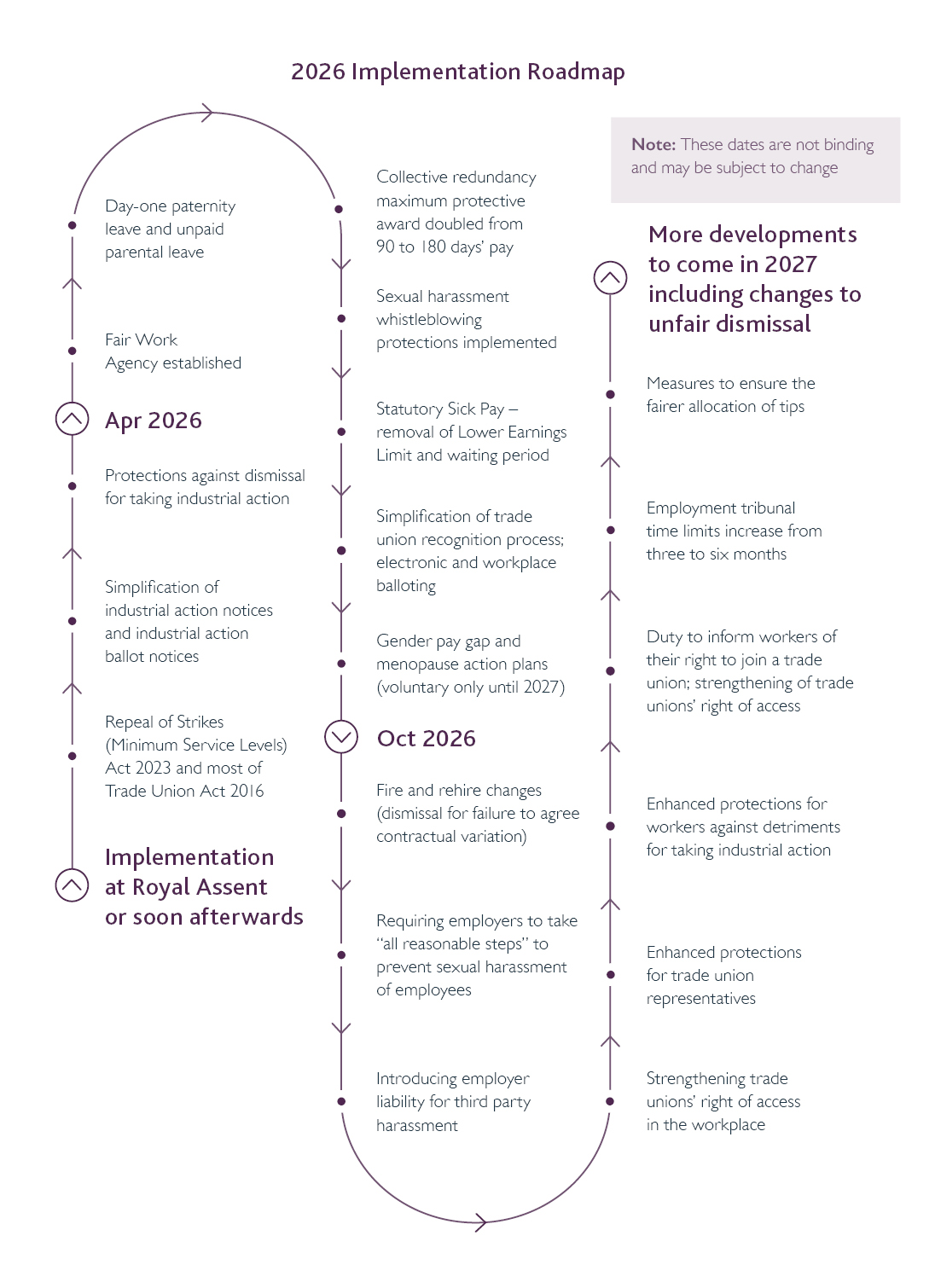
The Employment Rights Act 2025 (the Act), described by Prime Minister Kier Starmer as “the biggest upgrade to workers’ rights in a generation”, was one of 2025’s most significant pieces of UK legislation. It contains a set of reforms to implement Labour’s “Plan to Make Work Pay” published before the 2024 general election. Having received Royal Assent on 18 December last year, implementation of the Act will be staggered across 2026 and beyond. The UK government’s provisional roadmap outlines three waves of changes during 2026 – in February, April and October, shown in the timeline below. In this piece, we look at the key developments for employers. By taking a proactive approach, employers can mitigate risks, reduce potential costs and ensure compliance with increased standards.

February: Reshaping trade union rights

February will see the first wave of changes relating to trade unions and industrial action, although these are not expected to be the most fundamental of the changes. The main change is the repeal of most of the provisions of the Trade Union Act 2016, including those relating to industrial action ballots. We expect employers that are already unionised to feel the most impact.

April: More union changes (some) day one rights and new enforcement mechanisms

The introduction of electronic and workplace balloting for industrial action and other trade union matters is expected in April this year. This change will significantly broaden the scope of situations where unions may call for a ballot, no longer so constrained by costs and timing considerations.

The Act also simplifies the support required for trade union recognition in the final ballot, so that:

  • A simple majority of those voting is sufficient (turnout thresholds are removed)
  • It is no longer necessary to show at least 50% of workers in the bargaining unit are likely to support recognition

The requirement for union members among workers in the bargaining unit can be reduced from 10% to 2%, which could lead to larger bargaining units.

April will also see paternity leave, unpaid parental leave and statutory sick pay (SSP) all become “day one” rights. SSP will be extended to lower earners, albeit at a reduced rate. For employers, implementing these measures will lead to greater costs, and the need to update policies.

In terms of increased costs, another proposal is the increase in the maximum protective award for employers who fail to meet collective redundancy consultation obligations. The maximum award per affected employee will increase from 90 to 180 days’ pay.

The UK government has also announced the establishment of the Fair Work Agency (FWA). This agency will combine the various existing labour market enforcement functions (including national minimum wage enforcement, the employment tribunal penalty scheme, and powers to tackle labour exploitation and modern slavery), as well as introducing the enforcement of SSP and holiday pay. However, it may take some time before the FWA is fully up and running.

October: New protections against harassment restrictions, on ‘fire and rehire’ and new trade union rights

From October 2026, employers will once again become liable for harassment of their staff by third parties, such as customers and suppliers. One incident may suffice to fix the employer with liability, unless it can prove it took all reasonable steps to prevent third party harassment.

For the preventative duty on employers, the Act requires employers to take all reasonable steps (not just reasonable steps, as currently) to prevent sexual harassment.

Alongside these new protections, we will also see the implementation of the controversial fire and rehire changes. The Act will make employee dismissal automatically unfair where the employer is seeking to make a “restricted variation” to their contractual terms e.g. those relating to pay (including performance-related pay), pension, hours, and holidays. Employers must therefore examine contractual arrangements with employees and identify where greater flexibility is needed. Inserting or amending contractual variation clauses will not be “restricted variations” if done before October 2026, but will be thereafter – so preparedness is key.

Notably, October will also introduce a new broad right of access for trade unions. This will be both physical and electronic, to enable the recruitment of new members, facilitate collective bargaining or pursue one of the other recognised “access purposes”. Employers who are not currently unionised may need to consider preparing for a possible union approach.

Other related changes include new rights and protections for trade union representatives, extending protections against detriments for taking industrial action and a new duty to inform workers of their right to join a trade union.

The final significant change expected in October is the extension of employment tribunal time limits from three to six months. When combined with the sheer volume of new claims made possible by measures in the Act, it is likely to increase the number of tribunal claims being lodged, putting further strain on the tribunal system.

Preparing for a landmark year of employment law reform

In terms of new regulation, we expect 2026 to be the most demanding year for employers in decades. However, this marks the beginning of ongoing transformation, with additional major changes – such as guaranteed hours offers for workers on zero and low hours contracts – scheduled for 2027.

The biggest change for 2027 however will relate to unfair dismissal. In a significant u-turn just before Royal Assent, the government abandoned its manifesto commitment to introduce day one protection from unfair dismissal. Following discussions with trade unions and business representatives, the Act instead reduces the current two-year qualifying period for unfair dismissal to a six-month qualifying period. It also ensures that the qualifying period can only be further varied by primary legislation, reducing the scope for future changes.

Even more significantly, as part of the row back from day one unfair dismissal protection, the government introduced a clause into the Act to remove the cap on the unfair dismissal compensatory award. The cap currently stands at the lower of 52 weeks’ gross pay or £118,223. Removal of the cap is a major change to have been introduced so late in the Bill’s passage, and it will have considerable ramifications for how employers approach terminating employees, particularly high earners. The new regime for unfair dismissal is expected to take effect on 1 January 2027.

The breadth and depth of these changes will require careful consideration and coordination across your business. Now is the time to engage with the Act and develop an appropriate strategy.

See all

This material is provided for general information only. It does not constitute legal or other professional advice.