M&A Outlook for 2026

Dealmaking beyond the noise
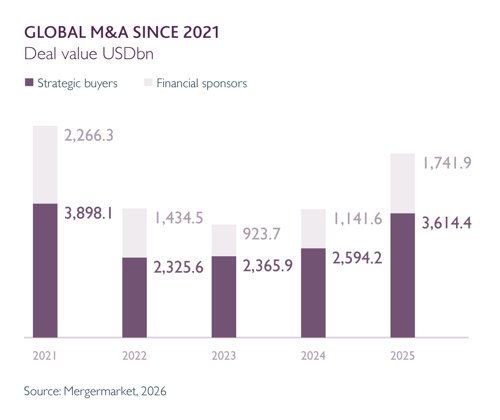
2025 was a year of fluctuating momentum. Dampened confidence at the start of year gave way to cautious optimism and a willingness to press on with corporate deal activity despite market volatility and geopolitical uncertainty. As this volatility increasingly becomes a constant structural factor, businesses are separating the signal from the noise and adjusting to this new normal by pressing ahead with opportunistic and strategic M&A, future-proofing their portfolios, and approaching dealmaking in adaptable and creative ways.

Our outlook for 2025 was optimistic; and for 2026 it remains cautiously so. In this latest publication, we look back at some of our predictions for 2025 and consider the main trends and developments we expect to see in 2026.

Trump, tensions and tariffs

At the start of 2025, we (like many) hoped that global political uncertainty driven primarily by elections in a number of key jurisdictions, was behind us; and that a convergence of significant M&A drivers (from strategic imperatives to private capital realisation) combined with greater flexibility shown by key regulators through 2025, would provide an uptick in market activity.


Whilst no one could have predicted the disruptive effect of President Trump’s Liberation Day tariffs, the speed with which the markets rallied was welcome, with the impact more muted than other recent global shocks (such as the COVID-19 pandemic and soaring interest rates). In particular, we saw a variety of deal and consideration structures being used to bridge valuation gaps and facilitate deal activity in this period of turbulence, including continued share-for-share deals, roll-over and stub equity and some relatively unusual, deferred consideration mechanisms. While deal value and volume dropped in the immediate wake of the US tariff announcements, momentum returned in early summer, driven in part by the conclusion of the UK-US trade deal and a gradual de-escalation of trade tensions with China. Global M&A deal value increased by 43% between 2024 and 2025, marking the strongest 12-month period since 2021. 2025 was a year of record - including the largest M&A deal since 2022 and the largest ever take-private, both in the US. Corporate separations were a key component of deal flow, and UK takeover activity surged throughout the year with H1 2025 marking the strongest six-month period for well over 15 years in volume (although not value) terms.

The UK broadly followed the global trend, albeit momentum slowed in the third and fourth quarters of 2025 ahead of the UK Budget in late-November, with some commentators concerned that this Autumnal hiatus may be an annual feature. With the Budget behind us, the current backdrop appears more conducive to M&A. With equity markets at record highs, IPO activity showing signs of life, volatility declining, and interest rates easing and expected to fall further, we expect these dynamics to continue supporting M&A activity through 2026. Transactions that benefit from valuation gaps between UK and US indices and market volatility will continue to thrive in the near term - including sponsor-backed public to private deal activity with the FTSE 350 continuing to be seen as being undervalued, and both buy- and sell-side distressed and turnaround opportunities. The fact volumes, rather than the value announced deals, have been down in 2025, suggests there are more deals to be done in 2026.

As global markets continue to shift with geopolitical tensions and competitive pressures, merger control too continues to undergo recalibration in the US, UK and EU. In the US in particular, domestic political dynamics and the shift towards political influence on enforcement outcomes is seen by some as a once in a lifetime opportunity to pursue mega-deals – such as HPE/Juniper (which is still subject to judicial review) and Union Pacific/Norfolk Southern. In the US, acquisitions valued at $10 billion above reached a record high. Overall though, with foundational principles remaining steady, we expect incremental change rather than sweeping reforms, certainly in the UK and Europe, and a need to focus on strategic foresight and thoughtful regulatory engagement. On the execution front, the number of antitrust and FDI filings having to be made on deals is becoming increasingly burdensome, time consuming and costly – and agreeing which filings can impact timetables is becoming an increasing focus.

Private capital at a crossroads

On exits, we expected the European IPO market to continue to search for positive momentum, and for corporate buyers to remain selective. Whilst we thought the cheaper cost of debt projected for 2025 would assist exit processes by enabling buyers to offer more compelling prices and reduce valuation gaps, that was not expected to be universal across asset classes. On the buy-side, we expected continued focus on deployment of dry powder, with sponsors using creative solutions to structure transactions and to allocate capital with precision.


Despite the well documented backlog of portfolio companies primed for exit and pressure on sponsors to return capital, we saw a sluggish start to the year, with much public and private deal activity on pause or taking much longer to implement. This was in part due to declining market valuations, exacerbated by tariff and wider uncertainty, which naturally reduced appetite for trade exits and delayed IPO processes. However, there is optimism this side of the Atlantic, with the reopening of the European market, seeing IPOs – like Verisure – across the Swiss, German and Nordic markets, and positive momentum in London too, with Q3 seeing the IPOs of Shawbrook, the Beauty Group and Princes. Stability will determine how far the markets can reopen, but in the UK, with a new favourable set of Listing Rules in full swing, interest rates on a downward path and inflation forecast to be at 2.5% in 2026, we foresee a healthy pipeline, particularly for IPOs sponsored by PE houses with portfolio companies too large for private sale.

On the buy-side, throughout the year, a combination of improved visibility on economic policy, rising public markets and ample dry powder created a favourable platform for funds to invest – particularly in the UK and Europe. We expect transactions in the near term to be opportunistic, heavily structured and subject to extensive negotiations, with a focus on industries less correlated to traditional business cycles, such as healthcare, financial services and defence. The uptick in IPOs allowing partial or full sponsor exits will add to the pool of deployable capital, and as confidence builds, so will competition for quality assets.

Will corporates remain “king”?

We expected corporate-to-corporate dealmaking to play a significant role in market activity in 2025 and that a greater availability of funding would result in more corporates being able to use debt to pursue transactions, whilst maintaining an opportunistic approach to M&A and a tight focus on capital allocation.


Dealmaking in 2025 was driven in large part by companies seeking to build future-proof portfolios – through scale, capability expansion and strategic divestitures. These imperatives, coupled with a tight focus on capital allocation, an ability to leverage strong balance sheets and the availability of financing, led to a continued dominance of corporate-to-corporate dealmaking through 2025, and we expect to see corporates continue to shape the market in 2026.

We are likely to see corporates pursuing both transformative mergers of equals and bolt-on acquisitions and using a variety of tactics to try to gain an edge over deep pocketed sponsors (including share-for-share bids, which are likely to remain attractive with stock indices at all time highs). At the same time, we expect companies to push forward with “corporate clarification” transactions – divesting businesses that will not serve them in a changing future whether as part of a wider strategic transformation, or in response to activist pressure on corporate strategy. We anticipate corporate separation and carve out activity to remain a prominent feature, with sponsor-backed buyers able to take advantage of prize assets too. The volume and value of UK carve outs, spin-offs and divestments is broadly in line year-on-year, with some large consumer goods companies taking the opportunity to divest non-core operations and brands in 2025, as they seek to refocus their portfolios (such as Reckitt/Essential).

These strategic moves will likely be defined by sectoral trends. We expect to see consolidation continue in the energy and natural resources space, with the growing energy demand for data centres, cloud computing and AI expected to accelerate deal activity as companies seek to acquire the infrastructure needed to power these technologies. Ongoing geopolitical tension will likely continue to drive investment and spending in growth-orientated M&A in aerospace, defence and cybersecurity in the UK, US and Europe.

2026 outlook

Overall, we are optimistic that the challenging environment that continues to shape market economics, strategic imperatives and regulatory reform will facilitate M&A in 2026, with businesses making bold, strategic moves despite high (but falling) interest rates, valuation gaps and disruptive technologies. The convergence of strategic imperatives – including private capital value realisation and business transformation – improving market sentiment and spending and investment commitments in some industries, suggests, absent any major macroeconomic or geopolitical shocks, a strong M&A roadmap for 2026.

See all

This material is provided for general information only. It does not constitute legal or other professional advice.