Boardroom Essential

February 2026

Download PDF version

Need to know for non-executive directors and senior management

Welcome to the Q1 issue of Boardroom Essential, our quarterly publication for non-executive directors and senior management.

If you have any colleagues who would may be interested in our content and like to sign up for our communications, please do email us.

Click on the titles below to jump to the topic you would like to read.

UK GOVERNMENT SCRAPS AUDIT REFORM AND CORPORATE GOVERNANCE BILL

In a Press Release on 20 January, the Secretary of State for Business and Trade, Peter Kyle, announced that the Government is scrapping the Audit Reform and Corporate Governance Bill in order “to avoid significant new costs for large firms”. This will be of particular interest to large unlisted businesses as the Bill would have placed increased reporting obligations on companies and LLPs with both 1,000+ employees and a turnover of £1 billion or more.

The announcement also states that the Government:

  • is pressing ahead with plans to allow (wholly) virtual AGMs and streamline corporate reporting, although the timing for these is still unclear;
  • is launching a consultation to speed up and simplify CMA investigations; and
  • will be launching regulatory reviews to simplify Health & Safety rules and streamline Farming and Agri-tech rules.

The Government will instead focus on a “sweeping package of growth measures”, as part of its Industrial Strategy. This includes the previously announced modernisation of corporate reporting programme, which aims to make the corporate reporting regime in the UK more streamlined and proportionate – see separate article in this issue.

Background

The announcement is a significant reversal in the long-running and troubled saga of audit and corporate governance reform which began in 2018, following the failure of Carillion, when Sir John Kingman was asked to undertake an independent review of the Financial Reporting Council (FRC). There followed various reports, white papers and consultations, punctuated by a series of delays, a pandemic, and a succession of Prime Ministers and Governments.

Progress finally seemed to be imminent when the Government announced the Audit Reform and Corporate Governance Bill in July 2024, with the Bill originally expected to be introduced for pre-legislative scrutiny in the current Parliamentary session. However, this was delayed due to the volume of legislation before Parliament and a consultation on certain aspects of the Bill, promised for autumn 2025, never materialised. These delays have now culminated in the Government’s decision not to consult at all and to scrap the Bill.

An impediment to implementation of audit and governance reforms has been the ongoing tension between the UK Government’s stated desires of strengthening the UK’s audit and corporate governance framework and, at the same time, positioning the UK capital markets as a more attractive place to do business. Tackling burdens on businesses has remained a key aim of the Government, including a commitment made in March 2025 to reduce the administrative costs of regulation for business by 25% by the end of Parliament.

Any future for audit reform?

Although progress has been made in certain areas, including amendments to the UK Corporate Governance Code’s provisions relating to risk and internal control, the timing and extent of any further audit and corporate governance reform is far from clear. In a letter from the Minister for Small Businesses and Economic Transformation addressed to the Chair of the Business and Trade Committee on 20 January, the Minister stressed the importance of audit regulation and states that the Government will still look to put the FRC on a statutory footing when parliamentary time allows, indicating that the Government has not completely abandoned the plan to replace the FRC with the proposed Audit, Reporting and Governance Authority (ARGA) (or Corporate Reporting Authority (CRA), as indicated by the Government in September 2025) in the future.

However, with the scrapping of the Bill, any further changes are likely to be in the distant future, with the focus in the near term on other measures aimed at reducing the regulatory burden on businesses and supporting growth. 

Back to the top

UK GOVERNMENT PRESSES AHEAD WITH MODERNISATION OF CORPORATE REPORTING PROGRAMME

Although the Government has decided not to consult on audit reform legislation, it has confirmed in its 20 January announcement that it is still planning a broad consultation under the Modernisation of Corporate Reporting programme in 2026. The Government has described the consultation as “ambitious”, with the intention that companies and investors “co-design” reforms to the existing framework. In the same announcement, the Government confirmed that it is also going ahead with plans to ensure that virtual-only general meetings are permitted under UK company law.

The Modernisation of Corporate Reporting programme will extend the existing review of non-financial reporting (which focused on narrative reporting) to the whole annual report and accounts as part of a holistic review of the UK corporate reporting framework. This is based on feedback that the non-financial reporting review did not go far enough. The goal is to refocus annual reports on concise, decision-relevant information for investors and creditors while removing unnecessary burdens, reflecting the overarching theme of balancing robust governance oversight with business agility and UK market competitiveness.

Overall, the Government aims to modernise and simplify the corporate reporting framework. Announced proposals include:

  • removing the requirement for all companies to produce a directors’ report, with some content relocated elsewhere in the annual report (including reporting on energy and emissions); and
  • exempting wholly-owned subsidiaries that are included in the reporting of a UK parent and most medium-sized companies from producing a strategic report.

This follows earlier changes to UK corporate reporting requirements aimed at decreasing administrative burdens on businesses, including increasing the monetary size thresholds for micro, small, medium and large-sized companies by approximately 50% and eliminating duplicative and redundant reporting requirements from the directors’ report and remuneration report.

The programme will encompass remuneration reporting, corporate governance reporting, financial reporting and alignment across reporting frameworks as well as corporate reporting in a digital age. Feedback from the non-financial reporting review had indicated that the varying reporting thresholds are overly complex.

Taken together, the Government’s decision to step back from audit reform legislation while pressing ahead with the Modernisation of Corporate Reporting programme signals a clear shift in focus: simplifying the reporting landscape, reducing unnecessary burdens and ensuring that disclosures remain meaningful for investors, creditors and other stakeholders. Although significant structural reform to the audit regime now appears unlikely in the near term, the forthcoming consultation will represent an important opportunity for companies, investors and other market participants to help shape a more coherent and modern reporting framework.

You can read more about the outlook for UK corporate governance in our UK Corporate Governance reform | Horizon Scanning programme.

Back to the top

AGM TRENDS: KEY TAKEAWAYS FOR THE FTSE 350 AND OUTLOOK FOR 2026

A number of trends have emerged from the 2025 AGM season of FTSE 350 companies. We highlight the key points for boards to bear in mind as we head into the 2026 AGM season.

Meeting format

Physical-only meetings – the format of choice: Physical-only AGMs became more dominant in 2025 as the proportion of the FTSE 350 holding physical-only AGMs increased again for the fourth consecutive year (to 72%). Meanwhile, the popularity of all other formats (physical meeting with a live webcast / broadcast / dial-in facility, hybrid and virtual) declined year-on-year.

72%

Physical-only meetings

Hybrid: The proportion of FTSE 350 companies holding hybrid AGMs (including so-called digitally enabled meetings) has declined again for the fourth consecutive year (to 15%). When hybrid meetings were held, the vast majority (86%) of attendees were physically present, compared to only 14% online. Given the complexity and cost of delivering hybrid meetings, we would expect the decline in their popularity to continue.

15%

Hybrid meetings

Virtual: Virtual meetings were the least popular format for FTSE 350 AGMs in 2025, making up only 1%. This is unsurprising given the current risk around the validity of fully virtual meetings – although this looks set to change as the Government proposes to amend the Companies Act 2006 to clarify that virtual meetings of shareholders are permitted.

1%

Virtual meetings

GC100 guidance on virtual meetings

In anticipation of the proposed Companies Act amendment, the GC100 has published guidance on good practice for virtual shareholder meetings which focuses on enabling shareholders to question and hold boards to account in the context of a virtual meeting. The timing of the amendment is unclear since the scrapping of the Audit Reform Bill, but the Government has said it is still committed to doing it. Realistically this is unlikely to happen until 2027 at the earliest. We may see some companies pre-emptively amending their articles during the 2026 AGM season to facilitate virtual meetings for such time as the law has been clarified (although we strongly advise that companies should wait till the law has been changed before holding a virtual-only meeting). However, we also expect many if not most companies will wait for another year, on the basis there is little benefit amending articles this year.

Pre-emption rights

Enhanced disapplication: We have not seen a significant increase in the number of FTSE 350 companies seeking enhanced disapplication authority based on the Pre-Emption Group’s 2022 Statement of Principles, suggesting that companies who want to seek additional headroom have already done so. We continue to see more uptake of additional disapplication in the FTSE 250, compared with the FTSE 100. We do not anticipate this to change in 2026 given heightened concerns around adverse reaction to the potential for significant dilution of FTSE 100 shareholders.


Dissent

Failed and requisitioned resolutions: Whilst the number of failed resolutions amongst the FTSE 350 is up slightly year-on-year, it has tracked below the five-year average in 2025. The majority of resolutions which did not pass were resolutions requisitioned by shareholders – and the 2025 AGM season has seen an increase in the number of requisitioned resolutions, which doubled year-on-year (to 6), albeit none of which were successful. With shareholder activism on the rise, and governance changes remaining a key theme of activism campaigns, we can expect to continue to see requisitions in the year ahead.


Remuneration

Shareholder sentiment: We have seen a small year-on-year decrease in shareholder support for the advisory resolution to approve remuneration reports, with the number receiving a substantial vote against more than doubling, although only one FTSE 100 company lost its remuneration report vote. However, shareholder support for remuneration policies increased slightly yearon- year, albeit that more policies received significant votes against the resolution than in the previous two years. The key areas of shareholder push back were perceived excessive incentive payouts and inappropriate uses of discretion, insufficient consideration of windfall gains and concerns about the alignment of incentive outcomes against the company’s actual performance.

93.7%

average vote percentage in favour of the remuneration report

Remuneration policies – the direction of travel: Broadly, the FTSE 250 were cautious in their approach to salary increases and other substantial changes in their 2025 policies. Within the FTSE 100, however, there were examples of some significant salary and variable pay increases, as well as structural changes to long-term incentive plans, with a number of companies looking to take advantage of the increased flexibility afforded by the Investment Association’s updated principles of remuneration. The majority of listed companies will have a remuneration policy approval vote in 2026, and we expect a number of companies, particularly those in the FTSE 100, to seek to make substantial amendments to their policies in the year ahead.

91.4%

average vote percentage in favour of the remuneration policy


Back to the top

ARTIFICIAL INTELLIGENCE - 2026 UPDATE

As AI continues to transform the business landscape, staying ahead of legal developments in this space has never been more critical.

Global regulation poses a particular challenge, with some jurisdictions adopting divergent approaches amid fierce international competition and concerns that excessive regulation could hinder innovation. At the same time, the way AI systems are trained and operate - and the way the market functions - creates unique legal risks prompting new legislation, regulatory guidance and case law across multiple areas.

In this update, we examine key developments across AI specific regulation, intellectual property, data privacy, AI litigation and competition law.

AI‑specific regulation

Regulators worldwide share many of the same concerns about AI risks, but their approaches can differ - reflecting not only legal traditions but also broader geopolitical objectives:

  • At one end of the spectrum, the US maintains a pro‑innovation, relatively light‑touch approach at federal level, although some individual states are introducing targeted AI laws.
  • At the other, the EU is pressing ahead with a comprehensive and highly structured AI regulatory regime. The EU AI Act has been in force since August 2024, with a staged implementation period of more than two years. However, the EU’s current drive to boost competitiveness, combined with the publication in November 2025 of the EU Digital Simplification Package – also known as the "Digital Omnibus" - means that some of the high‑risk AI rules originally due to apply from this summer will now be slightly delayed as will some of the transparency rules. Proposed amendments also include extending exemptions for SMEs and widening access to regulatory sandboxes, and strengthening the AI Office’s oversight of systems built on General Purpose AI (GPAI) models.
  • The UK’s approach sits somewhere in between the two, focusing on sector‑specific oversight and context. The Government has floated plans for an AI Bill for some time now, but its timing and precise scope remain uncertain. It is expected to be broader than originally anticipated - likely covering AI safety and potentially aspects of IP - but is not expected to mirror the EU’s regime.

Intellectual property

2025 was a significant year for AI‑related IP issues, and momentum will continue into 2026, with copyright again at the centre of debate.

In the UK, further clarity may emerge this year. The Government is due to publish two AI and copyright focussed reports by 18 March 2026 under the Data (Use and Access) Act 2025. The outcome of the consultation on AI and copyright is also due, setting out how the UK intends to balance the interests of AI developers and rights holders (such as media companies) in relation to what data can be used to train AI, as well as whether AI generated works should attract copyright protection. Additional guidance may address the treatment of models trained overseas, liability for infringing AI generated outputs, and the extent to which individuals can control the use of their likeness.

Developments are also expected across the EU. The European Commission is consulting on protocols for opting out of text‑and‑data mining (again, linked to AI training) and the Court of Justice of the European Union is set to deliver its first AI‑copyright judgment in late 2026 or early 2027. Additional decisions are anticipated in France and Germany as national courts grapple with similar issues.

Data privacy

AI continues to be a top priority for privacy regulators and legislators, who are trying to strike the right balance between enabling innovation and protecting individuals.

  • In the UK, the Data (Use and Access) Act 2025 will ease certain data protection constraints for AI, particularly in relation to automated decision‑making (ADM), while retaining strong safeguards for the highest‑risk uses.
  • Regulators on both sides of the Channel are preparing new guidance – for example the UK will publish updated ADM guidance this winter and The European Data Protection Board is developing guidance on the intersection of the GDPR and AI Act.
  • At the same time, UK and EU data protection authorities are increasing enforcement activity, with investigations targeting both AI developers and organisations deploying AI tools where those tools pose meaningful privacy risks.

AI litigation

As organisations adopt AI more widely, litigation risks continue to grow. The opacity of many models, the potential for inaccurate outputs or “hallucinations”, and the speed at which AI can scale errors all create fertile ground for claims.

Fundamental questions of legal liability remain unresolved: who should bear responsibility for AI‑driven errors - developers, deployers, or potentially neither? Courts will increasingly be asked to address these complex issues, which will shape future risk allocation.

Competition law

Competition authorities globally recognise both the transformative potential of AI and the risks of entrenched market dominance.

They are continuing to monitor partnerships and investments in AI markets under merger control and antitrust rules.

Meanwhile, antitrust enforcement is moving from theory to practice. Algorithmic collusion is central to the RealPage litigation in the US, and the European Commission has confirmed it is pursuing several algorithmic pricing investigations. Traditional concerns - including self‑preferencing, price discrimination, predation and tying - also remain active areas of scrutiny. The Commission has, for example, launched new probes into whether Google and Meta are favouring their own AI services.

Looking ahead, 2026 may bring clarity on the application of new digital markets regimes to AI. The UK regime is already flexible enough to include AI products and services if and when necessary. The position under the Digital Markets Act (DMA) is less clear, but we expect more certainty when the Commission concludes its DMA review in March.

Back to the top

IMPLEMENTING THE EMPLOYMENT RIGHTS ACT 2025: “MAKING WORK PAY” IN 2026

The Employment Rights Act 2025 (the Act), described by Prime Minister Kier Starmer as “the biggest upgrade to workers’ rights in a generation”, contains a set of reforms to implement Labour’s “Plan to Make Work Pay” published before the 2024 general election.

Implementation will be staggered across 2026 and beyond. The UK Government’s provisional roadmap outlines three waves of changes during 2026 – in February, April and October, shown in the timeline below. In this piece, we look at the key developments for employers. By taking a proactive approach, employers can mitigate risks, reduce potential costs and ensure compliance with increased standards.

February: Reshaping trade union rights

February will see the first wave of changes relating to trade unions and industrial action, although these are not expected to be the most fundamental of the changes. The main change is the repeal of most of the provisions of the Trade Union Act 2016, including those relating to industrial action ballots. We expect employers that are already unionised to feel the most impact.

April: More union changes, (some) day one rights and new enforcement mechanisms

There are a variety of union-related reforms expected in April, including changes which will broaden the situations where unions may call for a ballot.  

April will also see paternity leave, unpaid parental leave and statutory sick pay (SSP) all become “day one” rights. SSP will be extended to lower earners, albeit at a reduced rate. For employers, implementing these measures will lead to greater costs, and the need to update policies.

In terms of increased costs, another proposal is the increase in the maximum protective award for employers who fail to meet collective redundancy consultation obligations. The maximum award per affected employee will increase from 90 to 180 days’ pay.

The UK Government has also announced the establishment of the Fair Work Agency (FWA). This agency will combine the various existing labour market enforcement functions (including national minimum wage enforcement, the employment tribunal penalty scheme, and powers to tackle labour exploitation and modern slavery), as well as introducing the enforcement of SSP and holiday pay. However, it may take some time before the FWA is fully up and running.

October: New protections against harassment restrictions and on ‘fire and rehire’, together with new trade union rights

From October 2026, employers will once again become liable for harassment of their staff by third parties, such as customers and suppliers. One incident may suffice to fix the employer with liability, unless it can prove it took all reasonable steps to prevent third party harassment.

For the preventative duty on employers, the Act requires employers to take all reasonable steps (not just reasonable steps, as currently) to prevent sexual harassment.

Alongside these new protections, we will also see the implementation of the controversial fire and rehire changes. The Act will make employee dismissal automatically unfair where the employer is seeking to make a “restricted variation” to their contractual terms e.g. those relating to pay (including performance-related pay), pension, hours, and holidays. Employers must therefore examine contractual arrangements with employees and identify where greater flexibility is needed. Inserting or amending contractual variation clauses will not be “restricted variations” if done before October 2026 but will be thereafter – so preparedness is key.

Notably, October will also introduce a new broad right of access for trade unions. This will be both physical and electronic, to enable the recruitment of new members, facilitate collective bargaining or pursue one of the other recognised “access purposes”. Employers who are not currently unionised may need to consider preparing for a possible union approach.

The final significant change expected in October is the extension of employment tribunal time limits from three to six months. When combined with the sheer volume of new claims made possible by measures in the Act, it is likely to increase the number of tribunal claims being lodged, putting further strain on the tribunal system.

Preparing for a landmark year of employment law reform

In terms of new regulation, we expect 2026 to be the most demanding year for employers in decades.

However, this marks the beginning of ongoing transformation, with additional major changes – such as guaranteed hours offers for workers on zero and low hours contracts – scheduled for 2027.

The biggest change for 2027 however will relate to unfair dismissal. In a significant U-turn just before Royal Assent, the Government abandoned its manifesto commitment to introduce day-one protection from unfair dismissal. Following discussions with trade unions and business representatives, the Act instead reduces the current two-year qualifying period for unfair dismissal to six months. It also ensures that the qualifying period can only be further varied by primary legislation, reducing the scope for future changes.

Even more significantly, as part of the row back from day-one unfair dismissal protection, the Government introduced a clause into the Act to remove the cap on the unfair dismissal compensatory award. The cap currently stands at the lower of 52 weeks’ gross pay or £118,223. Removal of the cap is a major change to have been introduced so late in the Bill’s passage, and it will have considerable ramifications for how employers approach terminating employees, particularly high earners. The new regime for unfair dismissal is expected to take effect on 1 January 2027.

The breadth and depth of these changes will require careful consideration and coordination across businesses. Now is the time to engage with the Act and develop an appropriate strategy.

Click Infographic below to view.
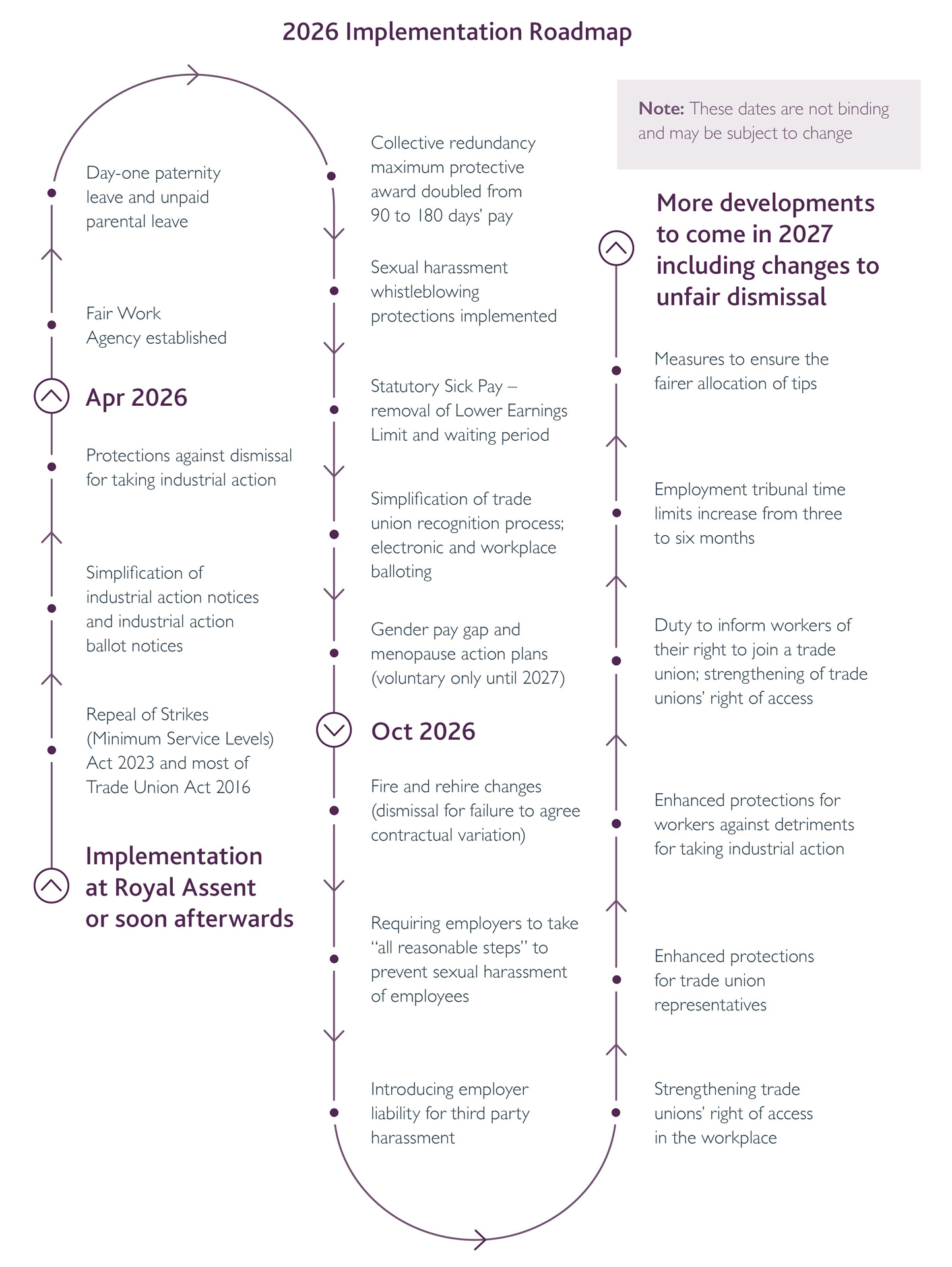
2026 Implementation Roadmap

Back to the top

If you would like more information on any of the matters covered, please do contact us, or speak to your usual Slaughter and May contact.

Contacts
Paul Dickson
Paul Dickson Partner
Tom Carey
Tom Carey Senior Knowledge Lawyer

This material is provided for general information only. It does not constitute legal or other professional advice.